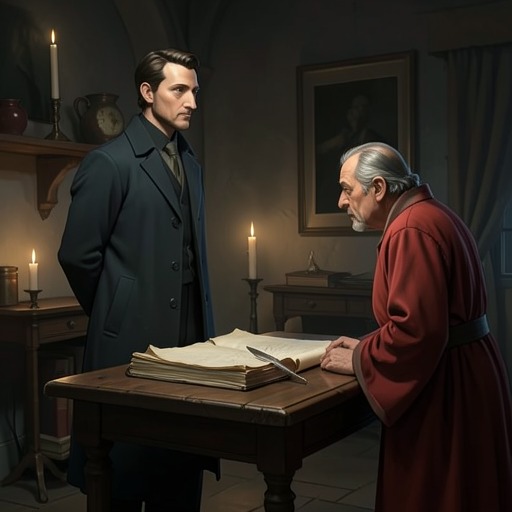
Harry Percy, Earl of Northumberland
Wolf HallHarry Percy, Earl of Northumberland, is a powerful northern nobleman whose earlier attachment to Anne Boleyn becomes a political danger when he claims that they had entered a binding marriage compact. His challenge threatens Anne’s advancement and Henry VIII’s plans; Thomas Cromwell counters it by invoking Percy’s debts, his duties to the Crown, and the authority of a public oath. Percy’s eventual denial clears the way for Anne, but leaves unresolved the contrast between his insistence on conscience and the pressure that secures his submission.
Identity and political position
Percy is the Earl of Northumberland, heir to a title and lands whose value lies not only in their antiquity but in the responsibilities attached to them. Cromwell describes the Percy and Howard families as essential to defending the north against Scotland. Percy, however, initially speaks as if inherited rank and ancient rights can shield him from royal demands. Cromwell’s answer is that an earldom is held from the king and entails the practical duty to keep men supplied, armed, and ready to serve.
The novel places Percy within a changing political order. In Cromwell’s account, power is not exercised only from border fortresses or the royal court: it also operates through Antwerp and Florence, through lenders, credit, and written obligations. Percy’s confidence in his title and tenants cannot protect him if his finances fail. His confrontation with Cromwell makes the gap between traditional aristocratic authority and the reach of financial networks into a personal crisis.
The disputed betrothal
Percy’s history with Anne reaches the present through competing accounts. Anne has previously been engaged to Percy, and Percy has told others that they made a compact before witnesses and were therefore not free to marry anyone else. He says that he swore to this account before, but that the late cardinal bullied him into withdrawing it; his father, he adds, threatened to remove him from the family line. With his father dead, Percy declares that he is no longer afraid to speak what he considers the truth.
The consequences of his claim spread beyond his former relationship with Anne. Percy says Anne is rightfully his wife and accuses Henry of taking another man’s wife. He imagines the king facing divine judgment without the protections of royal retinue. His statements arrive as Anne’s position is advancing, and her family fears that Percy’s testimony could expose a secret capable of obstructing her path to becoming queen. The story treats the alleged compact not as a private romantic dispute alone, but as a question with immediate consequences for the succession and the legitimacy of Henry’s plans.
Cromwell’s intervention
Cromwell meets Percy in a private room at the Mark and the Lion, where men in Percy’s livery occupy the inn and onlookers peer through a serving hatch. He asks why Percy cannot agree with his wife, Mary Talbot, and listens as the earl moves from his marriage to her back to Anne and the compact. Percy is not persuaded by a gentle appeal: he argues that he has a conscience too, and that the king’s public doubts about his own marriage make Percy’s doubts about his equally deserving of a hearing.
Cromwell answers by turning the dispute toward material and political vulnerability. He tells Percy that he knows how much money the earl has spent and how widely he has borrowed, and warns that his creditors could be called in. He then links Percy’s capacity to maintain his lands and title to the Crown’s military needs in the north. If Percy cannot provide for his men or maintain the defenses, Cromwell says, the king could take away his title, lands, and castles and entrust them to someone else. The argument makes financial credit a lever of government: Percy’s old status is not abolished, but its security is made conditional on solvency and service.
Cromwell also denies the legal force of Percy’s account, telling him that any promises he and Anne made did not amount to a binding pre-contract. He warns that further claims about Anne’s freedom will bring the Howards and Boleyns against him. Yet Cromwell’s final demand is pointedly practical: Percy must retract what he told Mary Talbot and take whatever oath is required to clear Anne’s way to become Queen of England. After the confrontation, Cromwell tells Wriothesley that he feels sorry for Percy, a brief acknowledgment of the human cost of the pressure he has applied.
Public oath and political outcome
The next day, Percy appears before the king’s council with red eyes, after resisting efforts by his attendants to clean him up. Henry VIII presides, and Thomas Audley, standing in for the Lord Chancellor, questions Percy about the supposed pre-contract, promises, and sexual relations with Anne. Percy denies each allegation. The king refuses to treat his word of honour as sufficient, given how far the matter has gone, and directs him to swear before the Archbishop of Canterbury.
The elderly Archbishop Warham struggles to rise and asks Percy to swear on the Bible, in the presence of the king and council, that he is free of both unlawful relations with Anne and any marriage contract. Percy rubs his eyes, extends his hand, and swears. The Duke of Norfolk immediately presents the affair as finished. Henry orders Norfolk not to trouble Percy further, has councillors assist Warham, and proposes that Percy seal the oath by receiving Holy Communion in the royal chapel. The sequence makes the change in Percy’s standing official: a disputed recollection becomes a denial witnessed by king, council, and archbishop, and then reinforced through a religious rite.
Percy’s submission clears the immediate obstacle to Anne’s advancement, but the scene does not settle what he privately believes about the past. His earlier testimony, his repeated changes of position as described by Warham, and the final public oath remain in tension. His story shows how a declaration can have decisive political force even when it is obtained amid financial pressure and the threat of losing title and lands. In the novel, Percy is therefore more than a former suitor: he is the point at which private conscience, aristocratic obligation, royal policy, and the performative power of law meet.